Giants
Paradise LostGiants are the prodigious offspring of ill-matched unions between the righteous Sons of God and the daughters of the wicked. They appear in Michael’s vision to Adam as “men of high renown,” but their fame is exposed as a moral distortion: a world that admires their immense bodies and battlefield power has learned to call destruction heroic virtue.
Origin and Nature
The Giants arise from unions that should never have been formed. Michael explains that when good is joined to evil, the result may be “prodigious Births of bodie or mind.” Their mixed origin therefore carries both physical and ethical significance. They are not simply large warriors; they are the embodied consequences of a corrupted alliance, in which incompatible moral orders are imprudently fused.
Their defining distinction is their extraordinary stature. Adam sees “Giants of mightie Bone” among the armed populations spread across the earth. Their bodily magnitude makes them conspicuous, but it also reveals the poem’s warning about appearance: the qualities most visible to the world—strength, size, courage, and military success—are precisely those that a fallen society is most likely to mistake for goodness.
Appearance in Michael’s Vision
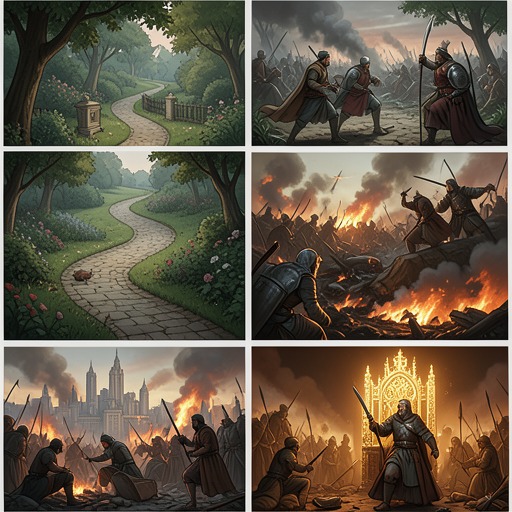
The Giants appear during Michael’s revelation of humanity’s violent future. Adam first sees towns, cities, towers, armed assemblies, threatening faces, cavalry, infantry, raiders, sieges, and fields abandoned to slaughter. The Giants belong to this landscape of organized violence rather than standing apart from it. Their presence helps define an age in which war has become a public measure of worth.
The vision shows warriors driving away cattle and flocks, attacking fortified cities by battery, scaling, and mine, and answering defenders with darts, javelins, stones, and sulfurous fire. Within this larger spectacle, the Giants represent the prestige attached to overwhelming force. The battlefield is not merely a place where they fight; it is the social theater in which their culture manufactures its idea of glory.
Power, Fame, and Violence
Michael states that in the Giants’ age, “Might onely shall be admir'd.” Valour and heroic virtue will be defined as the ability to overcome enemies in battle, subdue nations, and return with spoils gained through “infinite Man-slaughter.” Conquest will earn the titles of great conquerors, patrons of mankind, gods, and Sons of God, although Michael insists that such destroyers are more rightly called plagues of humanity.
This contrast between reputation and reality is central to the Giants’ significance. Their renown is genuine as a worldly phenomenon: they are celebrated, remembered, and treated as exemplars. Yet the very deeds that produce their fame conceal what most deserves judgment. The poem separates earthly acclaim from moral value, showing how a culture can make violence appear beneficent when it is performed on a sufficiently grand scale.
The Giants also intensify the pattern of fraternal violence established by the murder of Abel. Adam sees men killing men and asks how such mass slaughter can be anything other than a multiplication of the first brother’s sin. The Giants’ wars thus expand an individual crime into a social system. Their bodies are immense, but the ethical structure behind their power is recognizably human: domination turns fellow human beings into spoils, enemies, and expendable matter.
Narrative Function and Judgment
The Giants serve as evidence in Michael’s education of Adam. Their appearance follows the vision of seductive prosperity and corrupted marriage, allowing the angel to connect private disorder with public violence. The same fallen culture that yields itself to lust and abandons moral discipline also produces warriors who convert strength into authority and slaughter into honor.
Their story is therefore not an account of heroic achievement but a correction of heroic vocabulary. The culture names conquerors “Patrons of Mankind,” while Michael renames them destroyers and plagues. Through that reversal, the Giants expose the instability of fame: what the world celebrates may be exactly what divine judgment condemns. Their gigantic form becomes an outward emblem of an inward inflation, a civilization swollen with power but emptied of justice.
Against this violent ideal, Michael sets the solitary just man who is hated because he dares to remain righteous in a perverse world. The Giants belong to the majority that rewards force; the just man belongs to the threatened minority that preserves truth. Their opposition clarifies the poem’s moral scale. Greatness is not measured by the number of nations subdued or the magnitude of the slaughter, but by fidelity to justice when public opinion has made injustice glorious.